
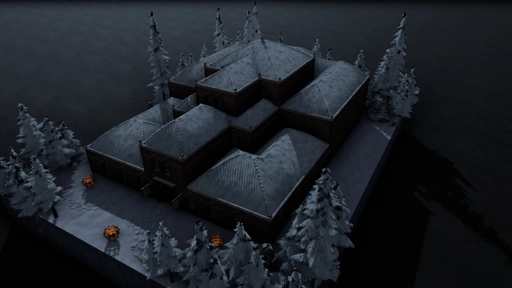

Some time ago, we started playing Icewind Dale – Rime of the Frostmaiden, which is a pre-written Dungeons & Dragons adventure published by Wizards of the Coast. The module allows for quite a bit room by way of homebrewing content, lore, and beasties, but also performs what all creative works should do well: It inspired. For the debut of our digital maps catalogue, we present to you The Frozen White Theatre.
The map acts as a stage (ha!) for re-enactments of historical legacies of whatever setting you’re playing in, allowing dungeon masters to perform an immersive lore dump to inattentive players.
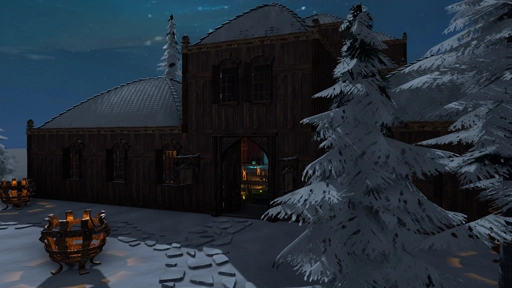
Imagine the following: The wind is howling in the northern plateau, the land gripped by the icy hand of winter. Most have hunkered down for the snowy season, limiting their labour and rationing their food. There’s enough to survive for the season, sure, though the true dangers of the bitter frost creep in after a few days, weeks, or months: boredom. So, the town comes together and announces that the theatre’s doors have swung open to invite all who have a few copper to spare and would like to burn a few hours!
Swing it whichever way you like. This kind of place shouldn’t exist this far north, or at all. Wooden signs creak in the wind, accompanied by the warm, orange glow of braziers promising warmth, stories, and a brief escape from a world that constantly threatens to freeze you solid within the walls of this three-storey building.
It’s so cold, my areolas can cut through glass.
The Theatre
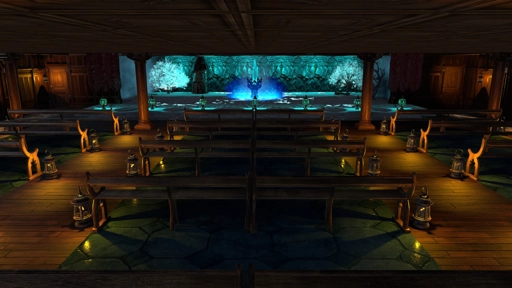
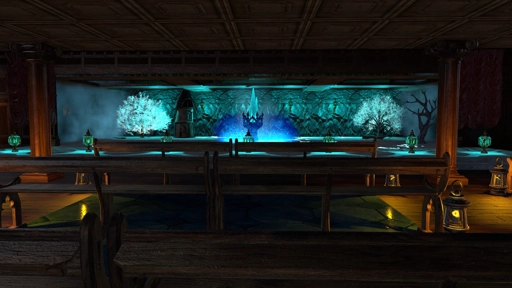
A warm orange glow is cast from lanterns enchanted by an eternal flame spell across finely polished wooden floors and benches, their monotony broken by the sweeping gloss of tilework which runs the length of the theatre. The stage looms ahead, decorated by haze-like landscapes, carefully brought into existence by illusion magic wielded by unseen hands. The line between what is real and what is not is blurred though, as physical props include a false back wall, some fake trees, a wizard’s tower and a large crystal gem. Heavy, red-dyed curtains hang at the edges of the stage, carving a path through the air for a series of dramatic reveals.
Players can be roped into the theatre experience by having them perform as stagehands or actors, battling against an increasingly unfortunate series of (extremely preventable) events that transpire during the play, such as the wrong backdrop for the scene being prepared, illusory errors, or risky stunts by making different skill checks. Potentially, players may notice that the fighting on the stage looks a bit too real, and that some of the “actors” might not be actors at all, and instead a group of individuals after a magical item or artifact which is being used as a prop.
Those blood splatter effects are insane! They should go international.
Operations

There’s a healthy number of places for players to be, both practically and tactically. Players acting as stagehands can lower props, control weather effects with their own illusion magic, or use the rafters as a vantage point for the entire play. For combat encounters, the drop down to the stage can hurt, so both the dungeon master as well as players can make liberal use of their grappling ability to make their quarry the actors’ problem. From above, a ranged character could also use the opportunity to rain hell down on foes below.

Behind and beside the stage there are a number of nooks and crannies to explore. A series of interactive levers control props as well as the curtains which dominate either edge of the stage, and a handsome scattering of storage containers with which to gain semi-valuable loot. Carefully consider whether wigs in your world cost as much as they do in real life, as that will determine whether the building contains a dragons’ hoard or not.
If the above piques your interest, then we’ll dive a bit into the mechanics and example encounters below.
You’re coooooooooked.
Example Encounters

Not all things have to be combat related, though flinging fireballs is fun. We’ll run through a few basic ideas that we’ve cooked up for things that can go wrong within the Frozen White Theatre.
The Play That Refuses to End
Everything starts off perfectly normal. Actors hit their marks, the crowd settles in, the illusion magic does its thing, and then… the scene just doesn’t end.
The curtains close.
The music dies.
The actors keep going.
Lines repeat, but not quite the same. Movements become slightly off. The illusion magic starts lagging behind them, showing things that weren’t part of the script — a different gesture here, a different outcome there. It’s like the play is trying to remember itself and getting it wrong.
At first, the audience thinks it’s avant-garde. Then it gets uncomfortable.
Turns out those enchanted lanterns lining the stage aren’t just for show. Something’s hijacked them, and instead of projecting scripted effects, they’re bleeding through… something else. Memory? Residue? A previous performance that didn’t go quite right?
Your players now have a few options:
- Break the magic before the actors lose themselves completely
- Dig into what the illusion is actually showing
- Or, if they’re brave (or stupid), let it play out and see how it ends this time
It’s like déjà vu, but I can’t recall the last time I got murdered.
Catwalk Collapse (Now Featuring Gravity)
Mid-performance, right as the big dramatic moment hits, something above the stage lets out a very unhealthy crack.
One of the catwalk supports gives way.
Now you’ve got:
- ropes snapping tension
- lanterns swinging like they’ve got a personal vendetta
- stagehands clinging to beams
- actors below trying very hard to pretend this is all part of the show
Meanwhile, backstage, that dwarven contraption is still doing its job — pulling levers, tightening lines, moving set pieces like nothing’s wrong.
Which means everything is getting worse. Quickly.
Your players are suddenly dealing with a vertical problem:
- climb up and stabilize the structure
- cut the right ropes (and not the ones holding someone’s entire spine together)
- or shut down the mechanism before the whole stage turns into a wooden meat grinder
Bonus points if the audience starts applauding halfway through.
She looks terrified! Bravo!
The Prop That Definitely Isn’t a Prop
You know that big crystal sitting centre stage? Yeah. That one. The one that’s “just a prop.”
It isn’t.
At first it’s subtle – the illusion magic around it looks a little too convincing. Light bends strangely. Shadows don’t quite match. Maybe someone in the audience feels a bit… off. Uneasy. Emotional for no clear reason.
Then it escalates.
The crystal starts pushing something back:
- whispers at the edge of hearing
- emotions bleeding through the crowd
- illusion effects becoming just a bit too real
And, because of course they are, someone in the building knows exactly what it is – and wants it.
Now you’ve got:
- a live performance
- a crowd that thinks this is all part of the show
- a very real relic doing very questionable things
- and possibly thieves moving through the chaos to grab it
Your players can:
- secure the artifact
- figure out what it’s actually doing
- or deal with the fallout when the “special effects” stop being special effects
Because nothing spices up a stage play quite like accidental reality.
Oh, the glowing green orb of murder-death-kill? It’s harmless.
The Dwarven Machine Was Not Built for This
Tucked away behind the stage sits the beating heart of the entire theatre: a hulking dwarven mechanism of gears, pulleys, and levers that controls everything from curtains to lighting to the occasional “actor takes flight” moment, and it works beautifully.
Until it doesn’t.
At some point during a performance, the machine starts… correcting things.
- Curtains snap shut too early
- Backdrops drop with bone-rattling force
- Ropes tighten with uncomfortable precision
- Actors get pulled into position instead of stepping into it
Whatever this thing was originally built for, it wasn’t theatre. It was adapted. Repurposed. Forced into a role it doesn’t quite understand.
And now it’s slipping back into its original function.
The stage stops feeling like a performance space and starts feeling like part of a mechanism; something to be adjusted, aligned, controlled.
Your players can:
- wrestle with the controls while the machine actively resists them
- trace the system to figure out what it was originally designed to do
- or shut it down entirely, plunging the theatre into chaos and darkness
Because right now, the theatre isn’t being run by stagehands. It’s being run by something that operates purely in in tension, weight, and force.
I’m about to optimize the shit out of this performance.
The Theatre That Remembers
Long after the audience has left and the fires have burned low, the theatre should be silent, but it isn’t… spooky, yeah?
At first, it’s easy to dismiss:
- a faint creak from the rafters
- the soft shift of wood settling in the cold
- maybe a distant thud somewhere backstage
Then it gets harder to ignore.
- quiet applause, just a few scattered claps
- a line whispered from the stage… with no one there
- the slow draw of curtains opening on their own
Step into the main hall, and you might catch it mid-act:
Lanterns flicker to life, shadows move across the stage, props shift into place like unseen hands are guiding them… The theatre is replaying something. Not perfectly. Not fully. Just fragments.
And if the players linger?
They may notice:
- positions on stage that feel right to stand in
- cues that seem to expect a response
- movements that feel… guided
The kind of subtle pull that says: You’re not the audience anymore. You’re part of the performance now, and the theatre would very much like the show to go on.
An elephant never forgets, but I forget what the elephant remembered.
All in all, there’s a lot of potential for The Frozen White Theatre, and you’re limited purely by your imagination. Such is the world of Dungeons & Dragons, after all, or whichever TTRPG you decide to adapt the map towards. What will you do when your players step into this spot of warmth, laying at the heart of the blistering cold?
If you are ready to venture forth, the map is ready for you. Jpeg, printable, VTT’s you name it. If it doesn’t have the format you need, contact us at [email protected] and we will sort you out.
